
How to Find Safe Overnight Truck Parking on Long Hauls

Finding a place to stop should be part of a long-haul plan, not the final decision of a tiring day. A driver can have a legal route, an on-time delivery, and plenty of fuel, yet still face a problem when the first truck stop is full. Parking shortages are a recognized safety issue: the Federal Highway Administration's Jason's Law truck-parking assessment describes crowded facilities, limited information about available spaces, and the pressure created by delivery schedules and required rest periods.
There is no single app or rule that guarantees a space every night. What works better is a repeatable routine: decide when the driving day should end, identify several legal options before starting, check them again while parked for a break, and leave enough time to reach a backup. This guide explains how to do that without treating parking as an afterthought.
Start With the Time You Need to Stop
Before looking for a truck stop, look at the hours available on your own clock. Federal hours-of-service rules govern the driving and duty periods of interstate property-carrying drivers; the FMCSA's driver guide explains those rules and their exceptions. Your electronic log and company procedures may add practical constraints. A parking plan should therefore be based on a realistic stopping time, not simply on the farthest point a mapping app says the truck could reach.
Build in a margin for congestion, bad weather, construction, fuel, and the slow last miles into a large travel center. If a facility is 20 minutes beyond the point where your available driving time would expire, it is not a useful primary stop. A detour to a safe legal location can take longer than the distance on a map suggests, especially near a city at rush hour.
Do the same calculation for the next morning. A parking space that is convenient tonight might force an awkward left turn, a difficult entrance to a shipper, or a long backtrack after the break. Compare your stopping choices with the appointment, the route restrictions, and the first fuel or service need of the following day.
Choose a Primary Stop and Two Backups
A useful plan has at least three plausible places to park: a preferred facility, a second option before it, and another legal option beyond it if time allows. Make a note of their exits, truck entrances, parking policies, and whether a space can be reserved. A backup that is closed to overnight truck parking is no backup at all.
Truck stops, public rest areas, authorized terminals, and prearranged customer or private lots can all be useful, but each has different rules and amenities. Do not assume that a shopping-center lot, an industrial street, a weigh station, or a highway ramp is legal just because trucks have parked there before. Signs, local rules, property-owner permission, and enforcement can change. When in doubt, call the location while safely stopped or choose a clearly designated facility.
Review the route with truck-specific navigation. Check bridge limits, low clearances, restricted roads, exit geometry, and whether the parking entrance is on the correct side of the highway. The final mile to a facility matters as much as the main interstate route. This is particularly important for wide loads, hazmat, or a trailer that is difficult to maneuver in a compact lot.
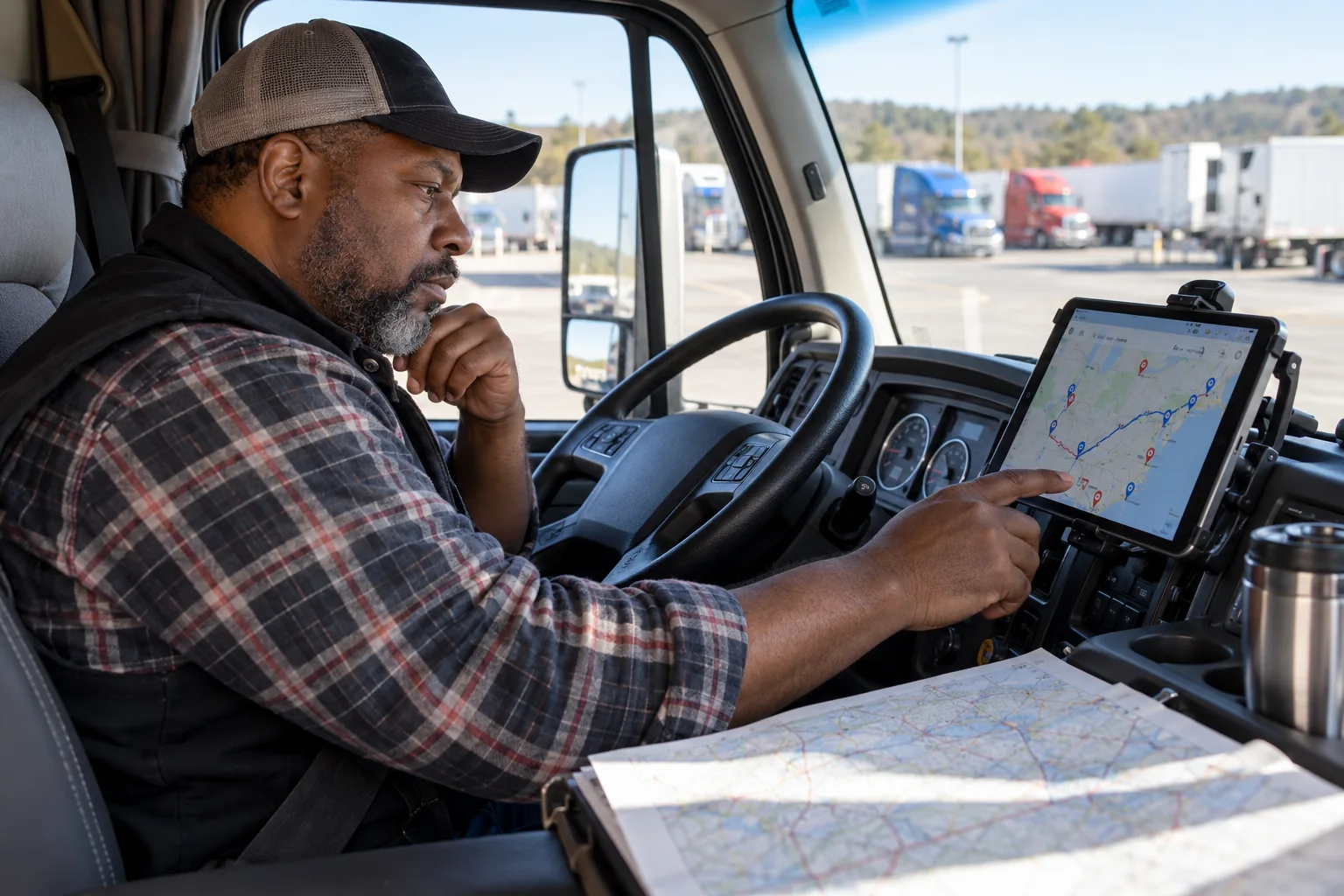
Use Parking Apps as Clues, Not Guarantees
Parking apps can save time by showing facilities, amenities, reviews, and reports from other drivers. Some states and corridors also display availability through public signs or online systems. But every number is a snapshot. A space reported open an hour ago may already be occupied when you arrive, and a truck stop's map pin may not lead to the truck entrance.
In a FHWA review of truck-parking tools, surveyed drivers valued mapping and driver reports about availability while also asking for more reliable, accurate information. The practical lesson is to cross-check. Compare the app's recent reports with the facility's own reservation system, state DOT information, and direct phone confirmation when the choice is important. Never interact with a phone while driving; make these checks during a scheduled stop or ask dispatch to help.
A reservation may be worth the fee on a route with few alternatives or a late arrival, but read the details. Confirm the correct date, arrival window, truck and trailer length, cancellation terms, and whether the reservation holds a specific space or only entry to a lot. Keep the confirmation available offline. If a facility is unavailable, change the plan before the clock is nearly exhausted.
Expect the Evening Rush
Demand often rises in the evening as drivers finish their day. FHWA's Truck Parking Development Handbook describes the difficulty drivers reported finding spaces at night. That does not mean every stop is full at the same hour. It does mean a plan that depends on a single popular lot at the end of the driving window has little resilience.
When the schedule allows, stopping a little earlier can be more valuable than trying to gain one more hour on the road. The trade-off is especially sensible before a major metropolitan area, at the edge of a mountain corridor, or on a route with long gaps between truck facilities. If a delivery appointment makes a late stop unavoidable, reserve a space where possible and identify another confirmed option nearby.
Dispatchers and fleet planners can help by avoiding delivery schedules that assume parking will always be available at the exact endpoint. Tell them early when a receiver delay or traffic jam changes the parking picture. A clear update about the remaining legal driving time is more useful than waiting until no safe option remains.
Evaluate the Lot Before Committing
Once you reach a facility, take a moment to assess it. Look for clearly marked truck spaces, adequate lighting, an unobstructed exit, visible security measures, and room to enter and leave without striking a curb or another trailer. A space beside a busy fuel island or the turn path of other trucks may be a poor choice even if it is technically open.
Use a slow, deliberate approach, particularly after dark. If backing is required, get out and look whenever the view is uncertain. Watch for pedestrians, parked vehicles, bollards, and a trailer overhang that may not appear in the mirrors. A crowded lot creates pressure to hurry, but a rushed maneuver can erase any time saved by stopping there.
After parking, secure the vehicle according to company procedures, lock the cab, and keep valuables out of sight. Note the lot's rules on idling, reefer operation, and overnight stays. If you need a shower, restroom, food, or accessible facilities, confirm those amenities before choosing a stop rather than assuming every site offers them all night.

Know When Fatigue Changes the Plan
A legal clock is not proof that a driver is fit to continue. If you are missing exits, drifting in the lane, having trouble focusing, or repeatedly yawning, treat those signs as a reason to stop safely. The FMCSA's driver-fatigue guidance emphasizes adequate sleep before driving, while the NHTSA's drowsy-driving advice warns that caffeine alone cannot replace sleep.
Do not press on toward a preferred facility simply because it has better food or a lower parking fee. Choose the nearest suitable legal place to stop and notify dispatch if the delivery plan must change. In an emergency, follow company procedure and local law. Avoid stopping on a shoulder or ramp as a substitute for planned parking; such locations can expose both the truck and passing motorists to serious risk.
A Five-Minute Parking Routine
Before departure, record the approximate time your driving period should end and save a primary truck parking location plus two legal alternatives. Check which facilities fit the vehicle, whether overnight parking is allowed, and which exits lead to the truck entrance. At a fuel or meal stop, refresh availability and weather information. If a delay makes the original target unrealistic, switch to the backup early. After parking, note anything useful for future trips: arrival time, whether spaces remained, entrance difficulties, lighting, and amenities.
That routine will not create more parking spaces, but it changes the driver's decision from a last-minute gamble into a controlled choice. The safest stopping plan is the one that leaves time to adjust when the first lot is full—and gives the driver a real opportunity to rest before the next leg.