
A Fog Plan for Truck Drivers Starts Before Visibility Falls
Fog can change a familiar route into a sequence of uncertain distances and difficult exits. A useful plan begins before that happens: check the forecast, identify suitable stopping options, and leave room in the schedule for conservative decisions. The priority is a clear view and a safe operating decision, not maintaining the progress expected in clear weather.
Read the forecast for the actual route
Check official weather information for the areas and times involved, including the final approach to the delivery. Conditions at the terminal may differ from those along the next stretch of road. Keep a way to receive appropriate updates without turning the driving period into a weather-search session.
The National Weather Service's fog-driving guidance provides general advice, including the use of low-beam headlights and allowing more time and space. Apply the carrier's commercial-vehicle procedures and the vehicle's instructions to the actual conditions rather than treating a short checklist as permission to continue.
Prepare visibility equipment while parked
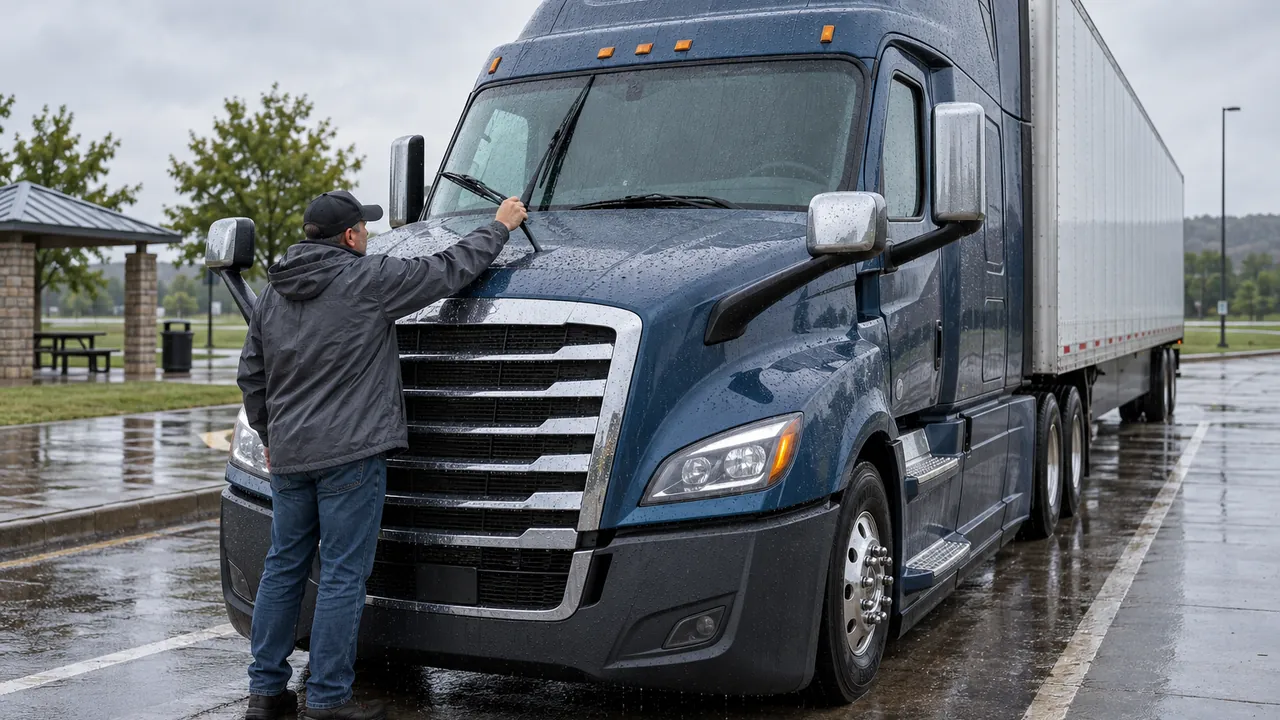
Check the windscreen, mirrors, lights, washers, and demisting arrangements through the normal approved inspection process. Familiarize yourself with controls before they are needed. Record and report equipment problems instead of assuming they can be managed by leaning forward or following another vehicle more closely.
Keep loose items clear of the working area and set navigation before departure. If a device or display requires attention later, use a suitable safe stopping place. Reduced visibility makes an already distracting adjustment more difficult to justify.
Keep decisions tied to what you can see
Follow training and carrier procedures for speed, spacing, and changing conditions. Do not use another driver's pace or tail lights as proof that you have an adequate view. A vehicle ahead may turn, stop, or leave the road, and its driver may also be struggling to judge the situation.
The FMCSA's following-distance guidance gives additional context for maintaining space. Avoid turning a general numerical example into a fixed target for every combination of visibility, road, load, and vehicle.
Identify a stopping decision before it becomes urgent
Consider suitable, authorized places to stop and the difficulty of entering them in poor visibility. Follow current warnings, closures, and the carrier's escalation process. If you cannot continue safely, communicate that fact through the appropriate channel when stopped rather than allowing an appointment estimate to make the safety decision.
Do not improvise a maneuver into an unsuitable shoulder or driveway simply to get out of the flow of traffic. Emergency circumstances require appropriate emergency procedures and assistance. Plan earlier so ordinary stopping choices remain available where possible.
Restart deliberately
Before moving again, reassess the conditions, equipment, route, and available time. An improvement at the parking location does not establish that the entire route has cleared. Update dispatch with factual information and revise the plan as necessary.
A useful fog plan contains fewer assumptions than a clear-weather schedule. It keeps weather, visibility, equipment, stopping options, and communication connected. That makes it easier to recognize when the original plan needs to change and to explain the decision without guessing how conditions will develop.
Related reading: Heavy Rain and Semi-Trucks: A Practical Wet-Weather Driving Plan